
You've been told you have a meniscal tear, yet pain, locking or loss of confidence continues after treatment or surgery. A Diagnostic First Session examines the knee and the wider neurological and movement patterns that may be contributing, then immediately retests relevant findings.
| 18 years clinical experience | 5-star Google reviews | Diagnostic first session | Free parking on site | Sessions available this week |
Pain along the inner or outer knee joint line. Clicking, catching, or locking sensations when walking or bending. Difficulty fully straightening the knee. Pain when twisting, pivoting, or changing direction. Swelling after activity that comes and goes. Pain getting up from a chair, out of a car, or on the stairs. Sharp discomfort during squatting or kneeling. A feeling of instability – like the knee can’t be trusted. Stiffness after rest that loosens off with movement. Symptoms that fluctuate unpredictably, sometimes better, sometimes worse for no obvious reason. You’ve been told you have a meniscal tear. Treatment hasn’t resolved it. That pattern is information – it’s telling you the cause hasn’t been found yet.
A knee that will not fully straighten needs careful assessment. A displaced meniscal tear can create a true mechanical block and may require prompt orthopaedic review, particularly after significant trauma. In other people, protective muscle activity and altered neurological control can create a locking sensation or restricted extension without a fixed obstruction.
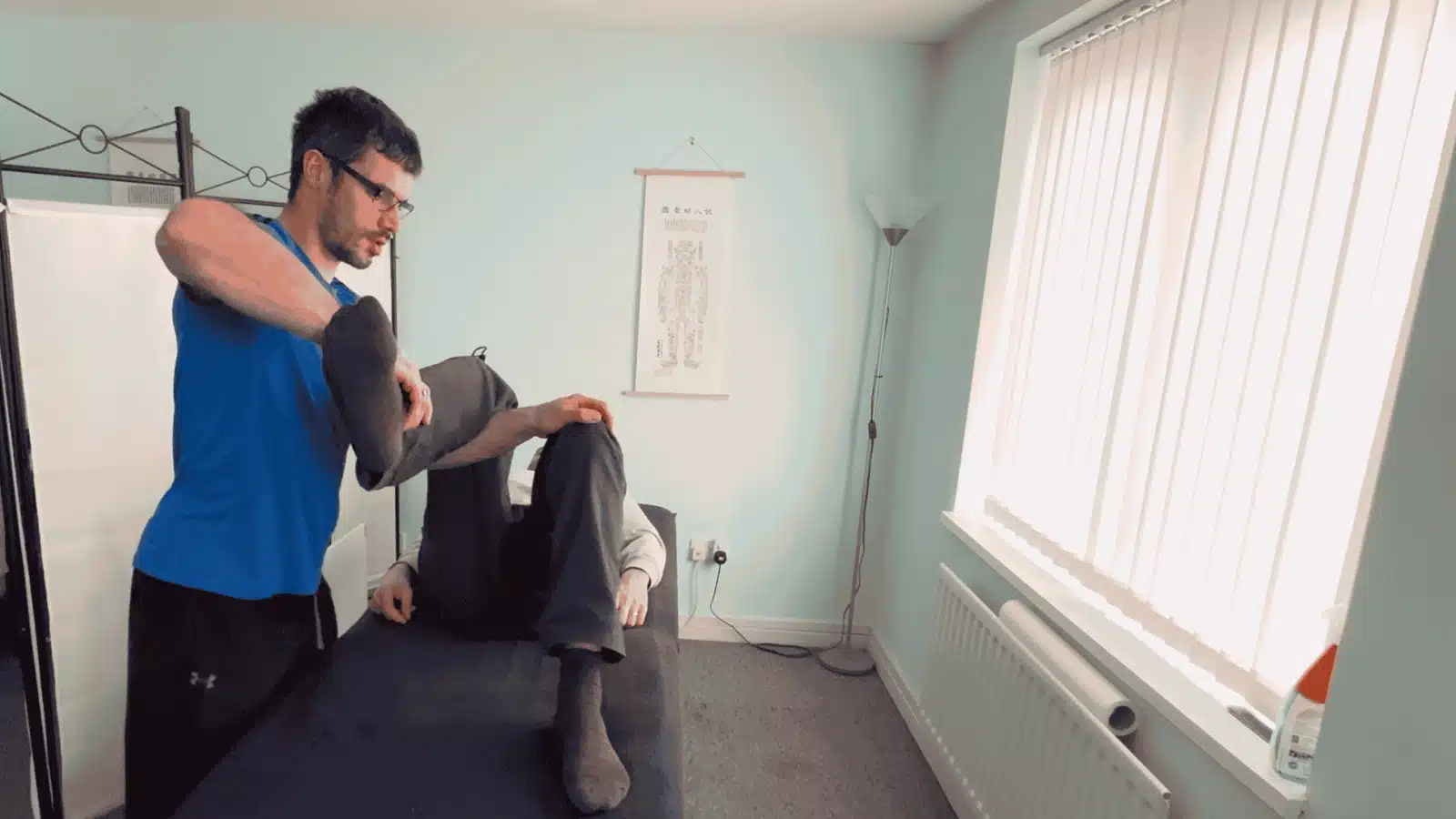
During assessment we test the knee, popliteus, hamstrings and relevant neurological patterns, then immediately retest movement after an appropriate input. When extension, strength or comfort changes in the room, that demonstrates a modifiable functional component. It does not prove that meniscal tissue has healed or that structural assessment is unnecessary.
The meniscus helps distribute load and contributes to knee stability. Its blood supply varies by region, so healing potential depends on the type and location of a tear. After the appropriate initial protection, graded movement is often useful for maintaining range, strength, confidence and joint function.
The right amount of movement is individual. We use comfortable, appropriately loaded exercise and retesting to find what the knee currently tolerates. The aim is to improve function and progressively restore capacity, not to claim that an immediate change represents instant tissue healing.
Joint-line pain can be associated with a meniscal injury, but nearby nerves, muscles and other structures can produce overlapping symptoms. We assess sensation, movement, strength and relevant nerve responses alongside the history and any imaging.
If a neurological or movement input changes pain or function on immediate retesting, it shows that the finding may be clinically relevant. It does not make the MRI finding irrelevant; it helps build a more complete explanation of what is driving the person’s current symptoms.
A scan may show a meniscal tear, but it cannot always explain why pain, locking or instability changes from one moment to the next. A functional-neurology assessment tests the knee and the wider system to identify what is contributing to the dysfunction.
No. Some tears absolutely require surgical intervention – particularly true mechanical locking injuries where tissue is physically blocking the joint. But many meniscal tears visible on MRI are also found in completely pain-free people. In those cases, the tear itself may not be the main pain generator. The key question isn’t simply “is there a tear?” It’s whether the tissue is structurally unstable, or whether the nervous system is over-protecting the knee around it. That distinction changes everything about how the problem should be approached.
One client arrived after months of persistent locking and joint-line pain, believing surgery was the only remaining option. Assessment showed the nervous system was strongly protecting the knee through popliteus spasm and altered loading patterns from an older lower limb injury. Once those drivers were addressed, the locking sensation resolved and normal movement returned – no surgical intervention needed.
Important – Some meniscal injuries do require orthopaedic assessment, particularly after significant trauma, true mechanical locking, or acute instability. Our role is not to dismiss structural injury. It is to determine whether the symptoms match the tissue findings, and to identify when neurological protection is amplifying the problem beyond the structural damage itself.
1. Unlock – We assess whether restricted extension changes when relevant muscular and neurological drivers are treated. Some clients demonstrate a substantial improvement in movement, strength or comfort during the first session. A knee that remains genuinely locked, particularly after trauma, requires appropriate medical or orthopaedic assessment.
2. Settle and restore control – We use appropriate movement and loading strategies to help the knee tolerate activity while monitoring swelling, pain and function.
3. Move – We prescribe graded, comfortable movement to maintain range, strength and knee function. Exercise is selected from the assessment rather than from a fixed protocol.
4. Strengthen – We build quadriceps, hamstrings, hip and trunk capacity where assessment shows it is relevant, so load is shared more effectively during walking, stairs and sport.
This is a test-and-retest process, not a guess. We look for measurable changes in movement, strength, coordination, comfort or confidence during the session. Many clients show a clear functional change in the room, although the response and number of sessions vary.
This approach may be relevant if your knee pain keeps returning despite physiotherapy or rehabilitation; your symptoms fluctuate despite a meniscal diagnosis; the knee feels guarded, unstable or difficult to straighten; progress has plateaued; or you have stopped training because the knee no longer feels trustworthy.
Breakthrough Pain & Performance works with people across Newcastle and the North East who have persistent knee pain or meniscus-related symptoms after treatment, injections or surgery. The entry point is a £100, 60-minute Diagnostic First Session in Shiremoor. It includes detailed assessment, treatment and immediate retesting where appropriate, a written report within 24 hours and an included 30–40 minute Zoom findings call. Free parking is available on site.
Yes. Meniscal changes can appear on MRI in people without symptoms, while in other cases the tear is clinically important. Pain may also be influenced by swelling, protective muscle activity, load tolerance and neurological control. The assessment compares the history, examination and imaging rather than assuming either that the tear explains everything or that it is irrelevant.
If the driver was neurological guarding rather than a mechanical block, surgery addresses the structural finding without correcting the protective pattern. The nervous system continues producing pain because the underlying threat signal hasn’t been cleared.
Pseudo-locking is a spasm of the Popliteus muscle that prevents full knee extension. It feels identical to a cartilage block but is entirely soft tissue. We test for this in the first session – if the knee opens fully with neurological release, surgery wasn’t the answer.
Some can. The outcome depends on the type of tear, the blood supply to the affected area, the stability of the tissue, and how the nervous system is responding around the injury.
Yes. Degenerative tears respond particularly well because the pain is almost always neurological and protective rather than mechanical. The structural change is real but it’s rarely the sole source of the symptoms.
MRI findings don’t always correlate directly with symptoms. Many people with meniscal tears visible on scans have no pain at all, while others with significant symptoms have relatively minor findings.
Yes, and often the people who benefit most are those whose surgery didn’t fully resolve the pain. The remaining symptoms are usually neurological rather than structural, which is exactly what we assess for.
| Cookie | Duration | Description |
|---|---|---|
| cookielawinfo-checkbox-analytics | 11 months | This cookie is set by GDPR Cookie Consent plugin. The cookie is used to store the user consent for the cookies in the category "Analytics". |
| cookielawinfo-checkbox-functional | 11 months | The cookie is set by GDPR cookie consent to record the user consent for the cookies in the category "Functional". |
| cookielawinfo-checkbox-necessary | 11 months | This cookie is set by GDPR Cookie Consent plugin. The cookies is used to store the user consent for the cookies in the category "Necessary". |
| cookielawinfo-checkbox-others | 11 months | This cookie is set by GDPR Cookie Consent plugin. The cookie is used to store the user consent for the cookies in the category "Other. |
| cookielawinfo-checkbox-performance | 11 months | This cookie is set by GDPR Cookie Consent plugin. The cookie is used to store the user consent for the cookies in the category "Performance". |
| viewed_cookie_policy | 11 months | The cookie is set by the GDPR Cookie Consent plugin and is used to store whether or not user has consented to the use of cookies. It does not store any personal data. |

WhatsApp us
Tell us what's going on and we'll send you the information that's actually relevant to your situation.
Already decided? Book your diagnostic first session →