You've been told you have a tear. You've had treatment. The pain keeps coming back. There's a reason for that - and it's not what most clinicians are looking for.
| 18 years clinical experience | 5-star Google reviews | Diagnostic first session | Free parking on site | Sessions available this week |
Pain along the inner or outer knee joint line. Clicking, catching, or locking sensations when walking or bending. Difficulty fully straightening the knee. Pain when twisting, pivoting, or changing direction. Swelling after activity that comes and goes. Pain getting up from a chair, out of a car, or on the stairs. Sharp discomfort during squatting or kneeling. A feeling of instability – like the knee can’t be trusted. Stiffness after rest that loosens off with movement. Symptoms that fluctuate unpredictably, sometimes better, sometimes worse for no obvious reason. You’ve been told you have a meniscal tear. Treatment hasn’t resolved it. That pattern is information – it’s telling you the cause hasn’t been found yet.
Patients with meniscus tears often report locking-they cannot fully straighten the knee. The assumption is that a flap of torn cartilage is physically blocking the joint (a “bucket handle” tear). While this happens, it is a surgical emergency.
However, in many cases, the locking is Pseudo-Locking. It is caused by a spasm of the Popliteus Muscle. This small muscle at the back of the knee is responsible for “unlocking” the knee to allow it to bend. If the knee is traumatised, the Popliteus goes into a massive protective spasm to hold the joint still. It acts like a doorstop.
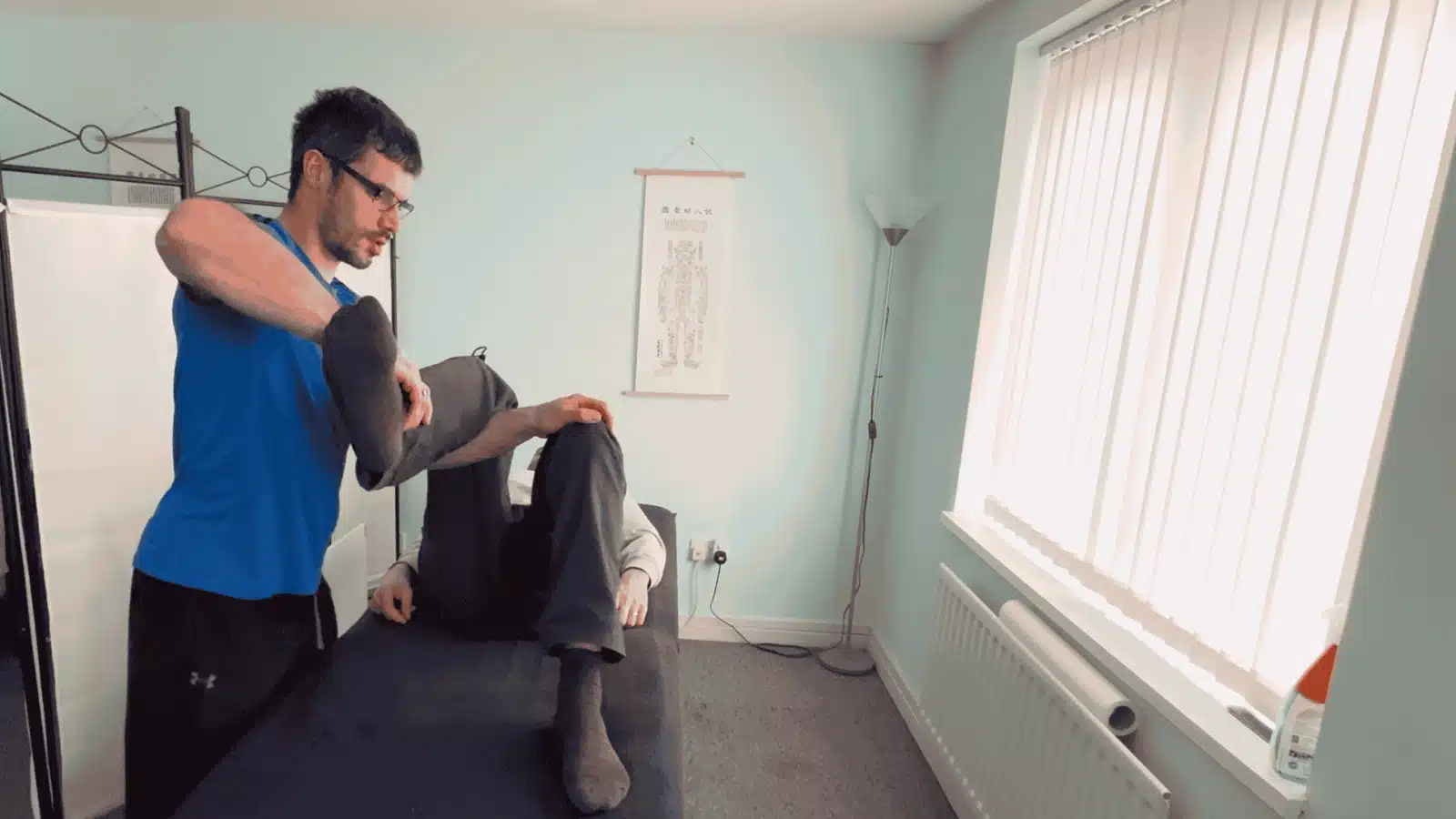
This feels exactly like a mechanical block. The joint won’t open. But it is soft tissue, not bone or cartilage. We treat the Popliteus neurologically. We use reflex points to tell the brain to release the spasm. In many cases, the “locked” knee opens up fully in a single session. This confirms that the meniscus was not the block, saving the patient from unnecessary surgery.
The outer third of the meniscus has a blood supply (the Red Zone), but the inner two-thirds (the White Zone) does not. It relies on Synovial Fluid for nutrition. This fluid is pumped into the cartilage when you move and compress the joint.
If you rest too much because of pain, the meniscus starves. It becomes brittle and painful. Healing stops.
We use safe, unloaded movement to feed the meniscus. We might use a stationary bike with zero resistance, or specific leg swinging drills. This pumps nutrient-rich fluid into the tear without stressing the fibres. We accelerate the healing process by facilitating the knee’s natural biology.
Pain on the joint line (the gap between the thigh and shin bones) is the classic sign of a meniscus tear. However, the Saphenous Nerve runs right over this area. If this nerve is entrapped or irritated-perhaps by tight muscles in the thigh or a knee brace-it causes burning pain exactly over the meniscus.
We differentiate between the two. We test the nerve mobility. If we can reproduce your pain by stretching the nerve, or relieve it by flossing the nerve, then the meniscus is likely an innocent bystander. Treating the nerve entrapment resolves the pain, regardless of what the MRI says about the cartilage.
In degenerative tears, the meniscus can be squeezed out of the joint (extrusion). This means it stops acting as a shock absorber. The bones start to touch.
The brain senses this loss of cushioning and tightens the hamstring and calf muscles to compress the joint for stability. This increased compression wears the joint out faster.
We focus on Unloading. We strengthen the Gluteus Maximus and Medius to take the load off the knee. If the hip is doing its job of absorbing shock during walking, the knee doesn’t have to. We teach you how to walk and run “softly,” using your muscles as shock absorbers rather than your joints.
No. Some tears absolutely require surgical intervention – particularly true mechanical locking injuries where tissue is physically blocking the joint. But many meniscal tears visible on MRI are also found in completely pain-free people. In those cases, the tear itself may not be the main pain generator. The key question isn’t simply “is there a tear?” It’s whether the tissue is structurally unstable, or whether the nervous system is over-protecting the knee around it. That distinction changes everything about how the problem should be approached.
One client arrived after months of persistent locking and joint-line pain, believing surgery was the only remaining option. Assessment showed the nervous system was strongly protecting the knee through popliteus spasm and altered loading patterns from an older lower limb injury. Once those drivers were addressed, the locking sensation resolved and normal movement returned – no surgical intervention needed.
Important – Some meniscal injuries do require orthopaedic assessment, particularly after significant trauma, true mechanical locking, or acute instability. Our role is not to dismiss structural injury. It is to determine whether the symptoms match the tissue findings, and to identify when neurological protection is amplifying the problem beyond the structural damage itself.
1. Unlock – We release the protective spasm in the Popliteus and Hamstring to restore full extension. Most people feel the knee open up within the same session – often for the first time in months.
2. De-Swell – We use lymphatic techniques to clear the fluid that’s been inhibiting your muscles. As the swelling reduces, strength and control begin to return naturally.
3. Feed – We prescribe gentle, high-repetition movement that pumps nutrient-rich fluid directly into the cartilage. This is how healing actually happens – not through rest, but through the right kind of movement at the right time.
4. Strengthen – We build the quads and glutes so they become the shock absorbers your knee has been missing. When the surrounding muscles do their job properly, the joint stops taking the punishment.
This is a process, not a guess. Every step is guided by what your body shows us, not by a standard protocol. And most people leave their first session feeling something has genuinely shifted.
This Approach May Be Relevant If – Your knee pain keeps returning despite physio or rehabilitation. You were told you have a meniscus tear but symptoms fluctuate unpredictably. Your knee feels locked but scans are unclear or inconclusive. You’ve tried physio but progress plateaued and hasn’t held. Your MRI findings don’t fully explain the symptoms you’re experiencing day to day. You feel instability or guarding more than sharp injury pain. You’ve stopped training or sport because the knee no longer feels trustworthy.
Breakthrough Pain & Performance works with people across Newcastle and the North East dealing with persistent knee pain and meniscus-related symptoms that haven’t responded to physio, injections, or surgery. Diagnostic first sessions are available at our clinic in Shiremoor, Newcastle, with free parking on site.
Yes, frequently. Many meniscal tears visible on MRI are present in people with no pain at all. The pain is often coming from the nervous system guarding around the tear rather than the tear itself. That’s why treating the tear doesn’t always resolve the pain.
If the driver was neurological guarding rather than a mechanical block, surgery addresses the structural finding without correcting the protective pattern. The nervous system continues producing pain because the underlying threat signal hasn’t been cleared.
Pseudo-locking is a spasm of the Popliteus muscle that prevents full knee extension. It feels identical to a cartilage block but is entirely soft tissue. We test for this in the first session – if the knee opens fully with neurological release, surgery wasn’t the answer.
Some can. The outcome depends on the type of tear, the blood supply to the affected area, the stability of the tissue, and how the nervous system is responding around the injury.
Yes. Degenerative tears respond particularly well because the pain is almost always neurological and protective rather than mechanical. The structural change is real but it’s rarely the sole source of the symptoms.
MRI findings don’t always correlate directly with symptoms. Many people with meniscal tears visible on scans have no pain at all, while others with significant symptoms have relatively minor findings.
Yes, and often the people who benefit most are those whose surgery didn’t fully resolve the pain. The remaining symptoms are usually neurological rather than structural, which is exactly what we assess for.
| Cookie | Duration | Description |
|---|---|---|
| cookielawinfo-checkbox-analytics | 11 months | This cookie is set by GDPR Cookie Consent plugin. The cookie is used to store the user consent for the cookies in the category "Analytics". |
| cookielawinfo-checkbox-functional | 11 months | The cookie is set by GDPR cookie consent to record the user consent for the cookies in the category "Functional". |
| cookielawinfo-checkbox-necessary | 11 months | This cookie is set by GDPR Cookie Consent plugin. The cookies is used to store the user consent for the cookies in the category "Necessary". |
| cookielawinfo-checkbox-others | 11 months | This cookie is set by GDPR Cookie Consent plugin. The cookie is used to store the user consent for the cookies in the category "Other. |
| cookielawinfo-checkbox-performance | 11 months | This cookie is set by GDPR Cookie Consent plugin. The cookie is used to store the user consent for the cookies in the category "Performance". |
| viewed_cookie_policy | 11 months | The cookie is set by the GDPR Cookie Consent plugin and is used to store whether or not user has consented to the use of cookies. It does not store any personal data. |

WhatsApp us
Tell us what's going on and we'll send you the information that's actually relevant to your situation.
Already decided? Book your diagnostic first session →