You reach for something on a shelf and your shoulder catches. You shift position in bed and the ache wakes you. You might have eased it with treatment, only for it to return when you get back to your usual routine.
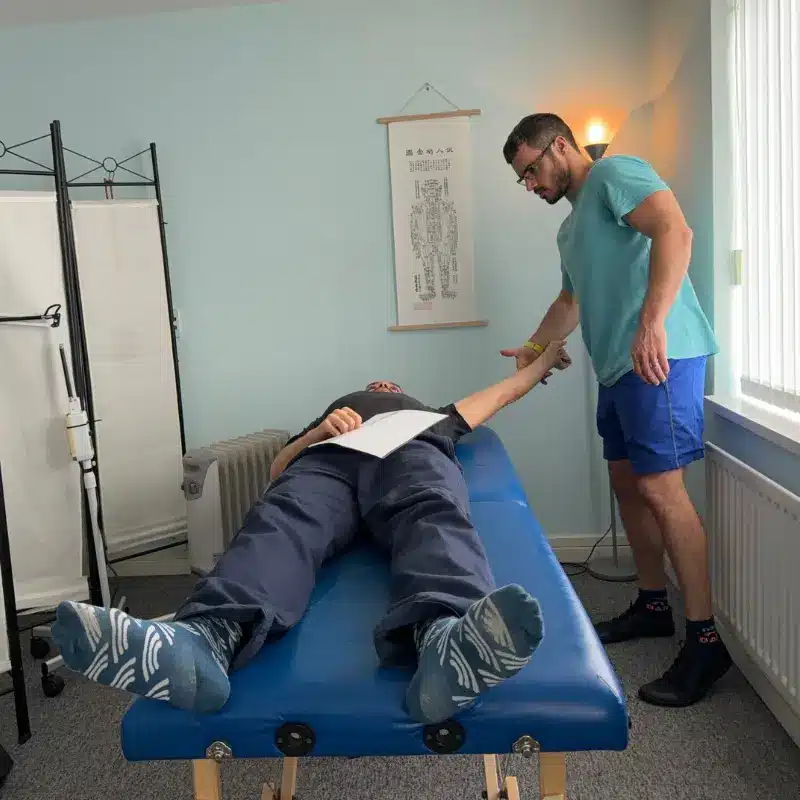
At our Shiremoor clinic, Sam checks how your shoulder moves and what happens when you reach, lift or load it. He treats relevant findings and repeats the tests so you can see what changes and understand what to work on next.
18 years’ clinical experience | Diagnostic First Session | Free on-site parking | Shiremoor, serving Newcastle and North Tyneside
You work around a shoulder that won’t move as freely as you want. You’ve changed how you train, adjusted how you sleep, or started doing ordinary tasks differently to avoid the uncomfortable range. Previous care may have helped for a while, yet you still hesitate to reach, lift or put weight through the shoulder.
You may have been told it is a rotator cuff problem, impingement, or wear and tear. You may have had injections that worked temporarily. You want to put on a jacket, reach up to a shelf or turn over in bed without planning around your shoulder.
The shoulder is often where pain is felt. It is not always where the problem originates. Sam considers how the shoulder moves alongside relevant findings in the neck, thoracic spine and elsewhere, guided by your history, current care and the activities you want to get back to.
Think of the process as peeling an onion. Findings guide the next step, then progress is checked. Where ongoing work is appropriate, the aim is to build function, strength and confidence towards what you want to do.
Before your appointment, Sam reviews what you’ve shared about your history and what you want to get back to doing. In the session, he starts by checking how you move and how your muscles respond to testing, giving you both a starting point for comparison.
Sam explains what he finds as he goes. When the next step depends on a finding, he treats it and immediately repeats the test so you can see how you respond. Each result helps guide the next step.
The aim is to work through the initial brain-based checks and then treat and retest a finding related to the shoulder movement you want to get back. That might be reaching overhead, putting on a jacket or getting into a lifting position.
At follow-up, Sam checks whether changes in the room are carrying over into what matters to you, such as sleeping more comfortably, reaching overhead or getting back to training.
Your 60-minute session begins with your history, current medical care, the pattern of your difficulties and what you want to get back to doing.
Sam carries out appropriate neurological and movement assessment and explains the findings in plain English.
Treatment and immediate retesting happen throughout the assessment. When the next step depends on a finding, Sam treats it and checks the response before moving on. You leave with one clear initial action or piece of guidance based on what the assessment showed. A change on retesting gives you a starting point. At follow-up, Sam checks whether reaching, lifting or sleeping is becoming easier in your daily life. You receive a written report within 24 hours, ahead of your Breakthrough Debrief. The included 30 to 40 minute Zoom findings call gives you time to discuss the report, ask questions and consider the next step without obligation.
Marco came to Sam for performance coaching. Assessment identified a shoulder limitation that was affecting what he could do in training, so they began with therapeutic work on pain and shoulder function to give him a stronger foundation before progressing to performance work.
Sam observed a rapid change in shoulder function during the first session. Six months into working together, Marco continued to move better through the shoulder, with ongoing work focused on performance. Sam describes the six-month follow-up. Marco shared his early experience in a Google review.
“I was impressed to see how the pain significantly subsided after having only 1 therapy session with Sam.”
Marco, Google review
Shaun Dixon sought help for recurring pain and restricted movement in his shoulder and hips. He reported that previous care had provided temporary relief. In his Google review, he described how improved movement made everyday tasks easier.
“It really has improved my day to day life, even with simple things that I struggled with like putting a jacket on.”
Marco and Shaun describe their individual experiences. At follow-up, progress is reviewed against what matters to each person.
Breakthrough Pain & Performance is based in Shiremoor, Newcastle, with free parking directly outside. Diagnostic First Sessions are available for people across North Tyneside, Newcastle, Whitley Bay, Wallsend and the surrounding areas dealing with persistent or recurring shoulder pain.
Shoulder pain can return for different reasons. Sam asks what improved, when it returned and which movements are still difficult. That helps him choose what to test and what to reassess at follow-up.
When relevant to your symptoms, Sam checks how your shoulder moves alongside your neck and upper back. The findings help guide the next test.
No. Retesting can show that a particular functional response changed during the session. Sustained improvement in pain and daily activity needs follow-up over time. Results and the amount of ongoing work vary.
Suitability depends on your symptoms and current care. Bring details of any diagnosis, imaging or previous treatment. Sam considers your full history alongside the movement and neurological findings. Do not change a rehabilitation or surgical plan without discussing it with the clinician responsible.
Yes. Bring details of your current care, medication and rehabilitation advice. Sam will discuss whether the Diagnostic First Session is suitable alongside the care you already receive. Continue prescribed care unless the clinician responsible advises otherwise.
Yes. Sam treats and retests findings throughout the assessment. The aim is to reach a finding related to your main shoulder concern in the first session. If the initial checks bring up several findings that need further treatment and retesting, Sam builds on those findings at a follow-up.
Sam responds the same day, usually within the hour, and aims to arrange sessions in the same week, subject to availability. Sending a booking request does not confirm an appointment or take payment.
For sudden or severe shoulder pain, pain after an injury, inability to move your arm or other urgent symptoms, follow NHS shoulder pain guidance and contact NHS 111 or ask for an urgent GP appointment. For sudden chest pain that spreads to an arm or comes with shortness of breath, call 999.
Tell Sam which movements are still difficult and what you want to get back to doing. Your £100 Diagnostic First Session is in Shiremoor, with free on-site parking. Sam replies the same day, usually within the hour, and aims to arrange your session in the same week, subject to availability.
Sending a request does not confirm an appointment or take payment.
| Cookie | Duration | Description |
|---|---|---|
| cookielawinfo-checkbox-analytics | 11 months | This cookie is set by GDPR Cookie Consent plugin. The cookie is used to store the user consent for the cookies in the category "Analytics". |
| cookielawinfo-checkbox-functional | 11 months | The cookie is set by GDPR cookie consent to record the user consent for the cookies in the category "Functional". |
| cookielawinfo-checkbox-necessary | 11 months | This cookie is set by GDPR Cookie Consent plugin. The cookies is used to store the user consent for the cookies in the category "Necessary". |
| cookielawinfo-checkbox-others | 11 months | This cookie is set by GDPR Cookie Consent plugin. The cookie is used to store the user consent for the cookies in the category "Other. |
| cookielawinfo-checkbox-performance | 11 months | This cookie is set by GDPR Cookie Consent plugin. The cookie is used to store the user consent for the cookies in the category "Performance". |
| viewed_cookie_policy | 11 months | The cookie is set by the GDPR Cookie Consent plugin and is used to store whether or not user has consented to the use of cookies. It does not store any personal data. |

WhatsApp us
Tell us what's going on and we'll send you the information that's actually relevant to your situation.
Already decided? Book your diagnostic first session →